

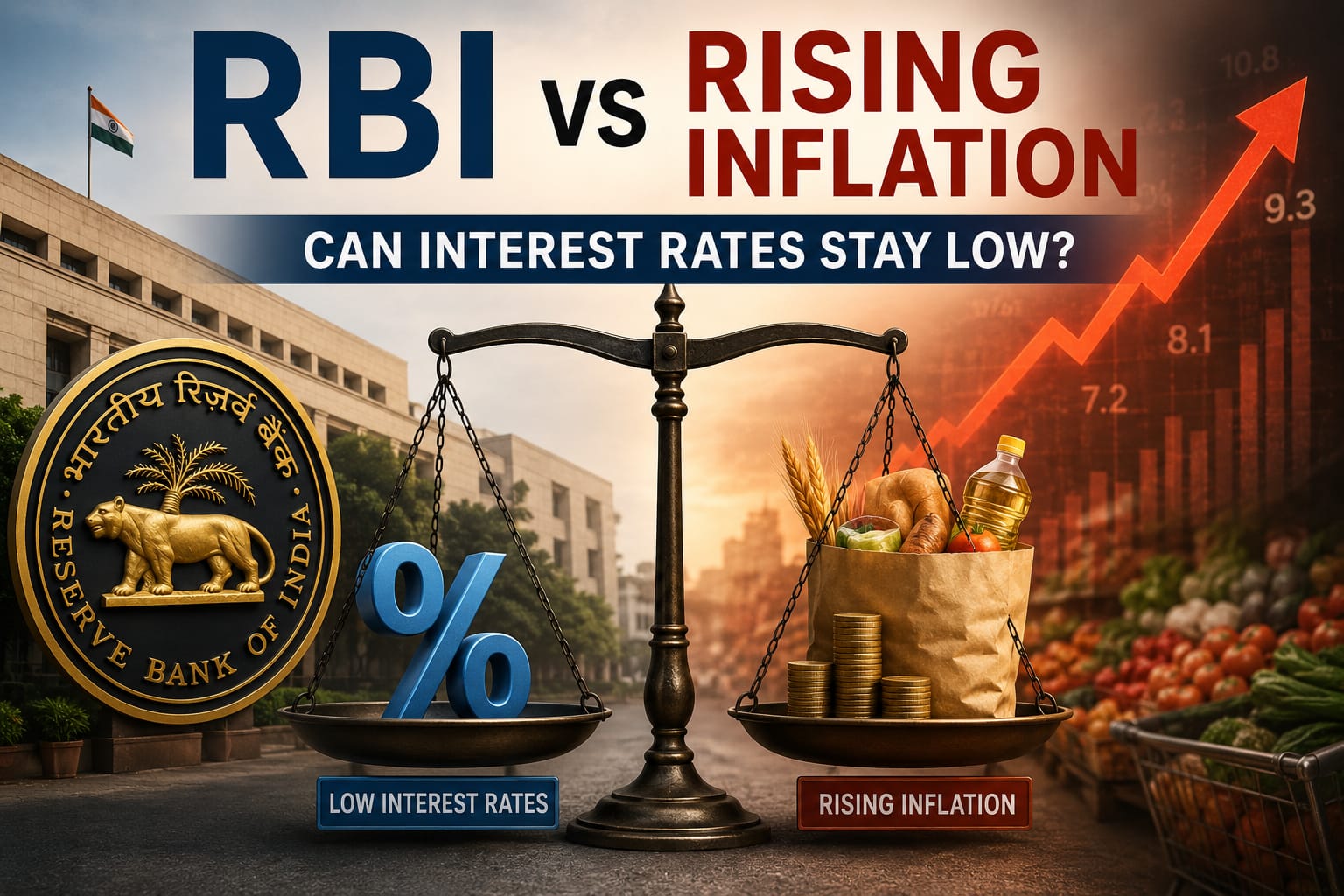
Inflation is rising, but the RBI is still holding interest rates steady. How long can it balance price stability with economic growth?
Why Is This Topic Important?
Interest rates affect almost everything—from home loans and EMIs to fixed deposits, business borrowing and stock-market valuations.
When inflation rises, the RBI faces a difficult choice: raise interest rates to control inflation or keep rates low to support economic growth?
In August 2026, the RBI kept the repo rate unchanged at 5.25% and retained its neutral stance, while lowering its FY27 inflation forecast to 5% and raising its GDP growth forecast to 6.7%.
| Rate | What it means | Why it matters |
|---|---|---|
| Repo Rate | Rate at which RBI lends short-term money to banks against securities | Directly influences loan and EMI rates and helps control inflation |
| SDF (Standing Deposit Facility) | Rate at which banks park surplus funds with RBI without collateral | Helps RBI absorb excess liquidity from the banking system |
| MSF (Marginal Standing Facility) | Emergency overnight borrowing facility for banks from RBI | Acts as a ceiling for short-term money-market rates |
| Bank Rate | Rate linked to certain RBI lending/penalty facilities | Influences the overall cost of borrowing in the financial system |
| Reverse Repo Rate | Rate at which RBI absorbs money from banks | Helps manage liquidity and short-term interest rates |
Why Does the RBI Raise Interest Rates?
The RBI may increase rates when inflation becomes persistent.
Higher interest rates can:
-
Make borrowing more expensive
-
Reduce excessive consumer spending
-
Slow down credit growth
-
Encourage saving
-
Reduce demand-side inflation
-
Help maintain price stability
When Can the RBI Keep Rates Low?
The RBI can maintain lower rates when:
-
Inflation remains manageable
-
Economic growth needs support
-
Demand is not overheating
-
Core inflation remains controlled
-
Global economic conditions are uncertain
However, if inflation becomes broad-based and persistent, keeping rates low for too long can become risky. Recent RBI minutes highlighted concerns that rising food, fuel and input costs could create broader inflationary pressure.
How Do Interest Rates Control Inflation?
Think of it like a speed control for the economy:
Inflation Rising → RBI raises rates → Borrowing becomes expensive → Spending may slow → Inflationary pressure can reduce
But:
Growth Weakening → RBI cuts/maintains lower rates → Borrowing becomes cheaper → Investment & consumption can increase → Growth gets support
Pros of Keeping Interest Rates Low
-
Cheaper home and personal loans
-
Lower EMIs for borrowers
-
Encourages business investment
-
Supports consumption
-
Can boost economic growth
-
Can support interest-sensitive sectors such as real estate and automobiles
Cons of Keeping Rates Too Low
-
Inflation may remain elevated
-
Excessive borrowing can increase
-
Savings may earn relatively lower returns
-
Asset prices can become overheated
-
Currency pressure may increase
-
Future rate hikes may become necessary if inflation becomes persistent
Recent Market Example – August 2026
In June 2026, India's retail inflation rose to 4.38%, moving above the RBI's 4% medium-term target for the first time in 17 months.
Despite inflation concerns, on 5 August 2026, the RBI kept the repo rate unchanged at 5.25%.
The reason? The RBI is balancing inflation risks against economic growth and global uncertainty. It also reduced its FY27 inflation forecast from 5.1% to 5% and raised its GDP growth projection to 6.7%.
What Could Happen Next?
If inflation remains contained, the RBI may continue its wait-and-watch approach.
But if food, fuel and input costs rise sharply and inflation becomes persistent, the RBI could consider tightening monetary policy later in FY27. Recent MPC minutes indicate that a rate hike could come into consideration if inflation risks intensify.
Final Takeaway
The RBI's challenge is not simply "Inflation or Growth?"
It is about finding the right balance between the two.
For now, the RBI is choosing caution over immediate rate changes. But if inflation becomes persistent, keeping rates low may no longer be an option.
Key Question for Investors:
Will inflation cool enough to keep interest rates stable—or will rising price pressures force the RBI to tighten again?
📌 Recent Market Example – 2026
In June 2026, India’s retail inflation rose to 4.38%, moving above the RBI’s 4% target.
Despite this, on 5 August 2026, the RBI kept the repo rate unchanged at 5.25%, choosing to support economic growth while monitoring inflation.
Simple takeaway:
👉 Inflation rising + RBI holding rates = RBI is balancing price stability with economic growth