

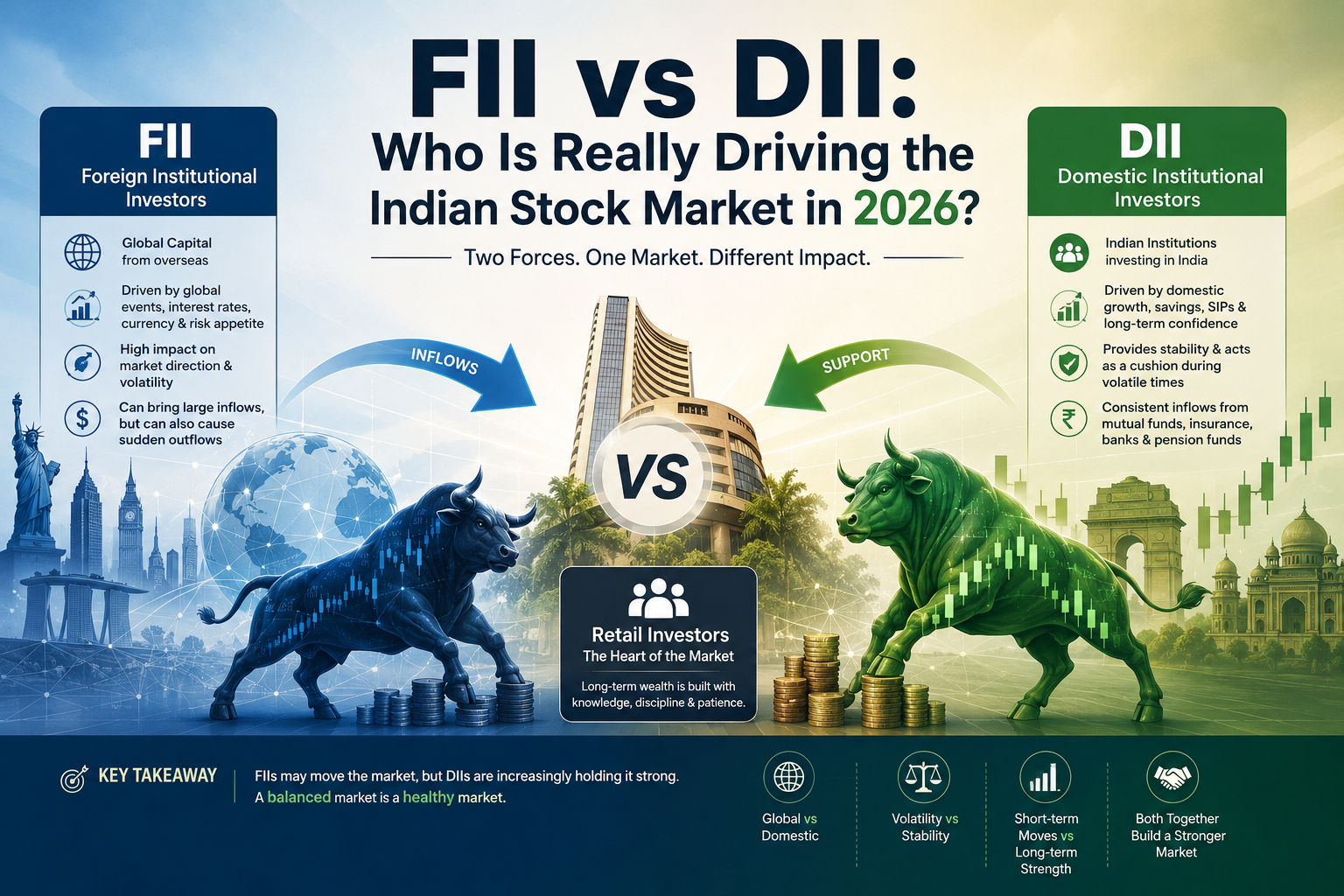
FII vs DII: Who Is Really Driving the Indian Stock Market in 2026?
The Indian stock market is influenced by many factors—corporate earnings, interest rates, inflation, crude oil, global markets and investor sentiment. But when it comes to understanding market liquidity and direction, two major players stand out: Foreign Institutional Investors (FIIs) and Domestic Institutional Investors (DIIs).
In 2026, the FII-DII battle has become particularly interesting. Foreign investors have remained major sellers for much of the year, while domestic institutions have continued to provide strong buying support. At the same time, August has seen signs of renewed FII interest, especially in sectors such as financials, automobiles and IT.
So, the big question is: Who is really driving the Indian stock market in 2026—FIIs or DIIs?
What Are FIIs and DIIs?
FIIs – Foreign Institutional Investors
FIIs, commonly referred to today as FPIs, are foreign institutions that invest in Indian financial markets. These may include:
-
Global mutual funds
-
Pension funds
-
Sovereign wealth funds
-
Foreign banks
-
Insurance companies
-
Global asset managers
Because they manage large pools of international capital, their buying and selling can have a significant impact on Indian markets.
DIIs – Domestic Institutional Investors
DIIs are institutions based in India that invest domestic capital in financial markets. They include:
-
Mutual funds
-
Insurance companies
-
Pension funds
-
Banks
-
Domestic financial institutions
The growing SIP culture and increasing participation in mutual funds have strengthened the role of DIIs in supporting Indian equities.
Why Do FII and DII Flows Matter?
Institutional investors deal with very large amounts of capital. Therefore, their buying and selling can influence:
-
Market liquidity
-
Stock prices
-
Index movements
-
Investor sentiment
-
Sector rotation
-
Market volatility
For example, heavy FII selling can put pressure on major indices, while strong DII buying can absorb some of that selling pressure.
This is one reason investors regularly track FII-DII cash-market data.
When Do FIIs Usually Buy or Sell?
FII activity is strongly influenced by global and macroeconomic conditions.
FIIs may increase buying when:
-
Global interest rates are expected to fall
-
The US dollar weakens
-
Indian corporate earnings improve
-
Indian valuations become more attractive
-
Global risk appetite increases
-
India's economic growth outlook remains strong
On the other hand, FIIs may sell when:
-
US bond yields rise
-
The dollar strengthens
-
Geopolitical tensions increase
-
Crude oil prices rise sharply
-
Emerging-market risk increases
-
Indian valuations appear expensive
In 2026, global uncertainty, crude prices, currency movements and international interest-rate expectations have remained important factors influencing foreign flows.
When Do DIIs Become More Important?
DIIs can become particularly important when foreign investors are selling.
Domestic institutions have a relatively more stable source of capital because a significant portion of their investments comes from domestic savings and systematic investment flows.
For example, on August 13, 2026, DIIs recorded net buying of approximately ₹4,353 crore even as FIIs were net sellers of about ₹511 crore.
This illustrates an important market dynamic:
FII selling does not automatically mean the Indian market must fall.
If domestic institutions continue buying, they can absorb part of the selling pressure.
How Do FIIs and DIIs Affect the Market?
Think of the market as a large pool of liquidity.
FII Buying → More liquidity → Higher demand → Potential upward pressure
FII Selling → Less liquidity → Higher selling pressure → Potential downward pressure
Similarly:
DII Buying → Domestic liquidity support → Buying cushion → Greater market resilience
DII Selling → Reduced domestic support → Additional selling pressure
However, FII-DII data should not be viewed as a standalone indicator. Institutional flows tell us about what large investors are doing, but not necessarily why they are doing it.
FII vs DII: Pros and Cons
| Factor | FIIs | DIIs |
|---|---|---|
| Capital source | Global | Domestic |
| Market impact | Often strong | Increasingly strong |
| Reaction to global events | High | Relatively lower |
| Investment horizon | Can vary widely | Often more stable |
| Sensitivity to currency | High | Lower |
| Main strength | Large global capital | Domestic liquidity |
| Main risk | Sudden outflows | Domestic sentiment/economic conditions |
Pros of FII Participation
1. Brings global capital
Foreign investment adds liquidity to Indian markets.
2. Improves market depth
Large institutional participation can improve trading activity and price discovery.
3. Supports corporate growth
Foreign capital can help Indian companies access a wider investment base.
4. Connects India with global markets
FII participation integrates Indian markets more closely with global capital markets.
Cons of FII Participation
1. Can increase volatility
Large-scale foreign selling can put significant pressure on markets.
2. Sensitive to global events
FIIs may change their allocation based on developments outside India.
3. Currency risk
Changes in the rupee can influence foreign investors' returns.
4. Sudden capital outflows
A global risk-off environment can lead to rapid withdrawal of foreign capital.
Pros of DII Participation
1. Provides domestic stability
Domestic institutions can act as a counterbalance during periods of heavy FII selling.
2. Supported by domestic savings
Mutual fund SIPs and insurance investments provide recurring domestic flows.
3. Less dependent on global sentiment
DIIs are generally more connected to India's domestic economic environment.
4. Strengthens India's market resilience
A stronger domestic investor base can reduce India's dependence on foreign capital.
Cons of DII Participation
1. Domestic risks still matter
Weak economic growth or poor corporate earnings can affect DII flows.
2. Valuation concerns
Strong domestic inflows can sometimes support expensive valuations.
3. Concentration risk
Large institutional flows may become concentrated in particular sectors or companies.
So, Who Is Really Driving the Market in 2026?
The answer is both—but in different ways.
FIIs often have greater influence on short-term market direction, particularly when global risk appetite changes.
DIIs are increasingly important for the market's underlying resilience, especially when foreign investors are selling.
The 2026 picture makes this distinction clear. While foreign investors have faced a challenging year, August has brought renewed FII buying, including significant purchases in financial stocks. At the same time, domestic institutions have continued to provide substantial support.
This suggests that India's market is gradually becoming less dependent on a single source of institutional liquidity.
What Should Investors Watch?
Instead of looking at FII or DII data in isolation, investors should track it alongside:
-
FII and DII net flows
-
Nifty and Sensex trends
-
Corporate earnings
-
RBI interest-rate decisions
-
US Federal Reserve policy
-
US bond yields
-
Rupee movement
-
Crude oil prices
-
Global geopolitical developments
-
Market valuations
The combination of these factors provides a much clearer picture than institutional flow data alone.
Final Takeaway
FIIs may still be the market's global steering wheel, but DIIs are increasingly becoming its domestic shock absorber.
The real story of India's stock market in 2026 is therefore not simply FII vs DII. It is the growing balance between foreign capital and domestic financial strength.
For investors, the key lesson is simple:
Don't just ask, "Are FIIs buying or selling?"
Ask:
"Why are they buying or selling—and what are DIIs doing at the same time?"
That is where the real market signal lies.
📌 Recent Market Example – August 2026
On 13 August 2026, FIIs sold ₹510.69 crore, while DIIs bought ₹4,353.09 crore.
👉 This shows how strong DII buying can absorb FII selling pressure and provide stability to the Indian market.
Key takeaway: FIIs may drive short-term volatility, but DIIs are increasingly supporting market stability.