

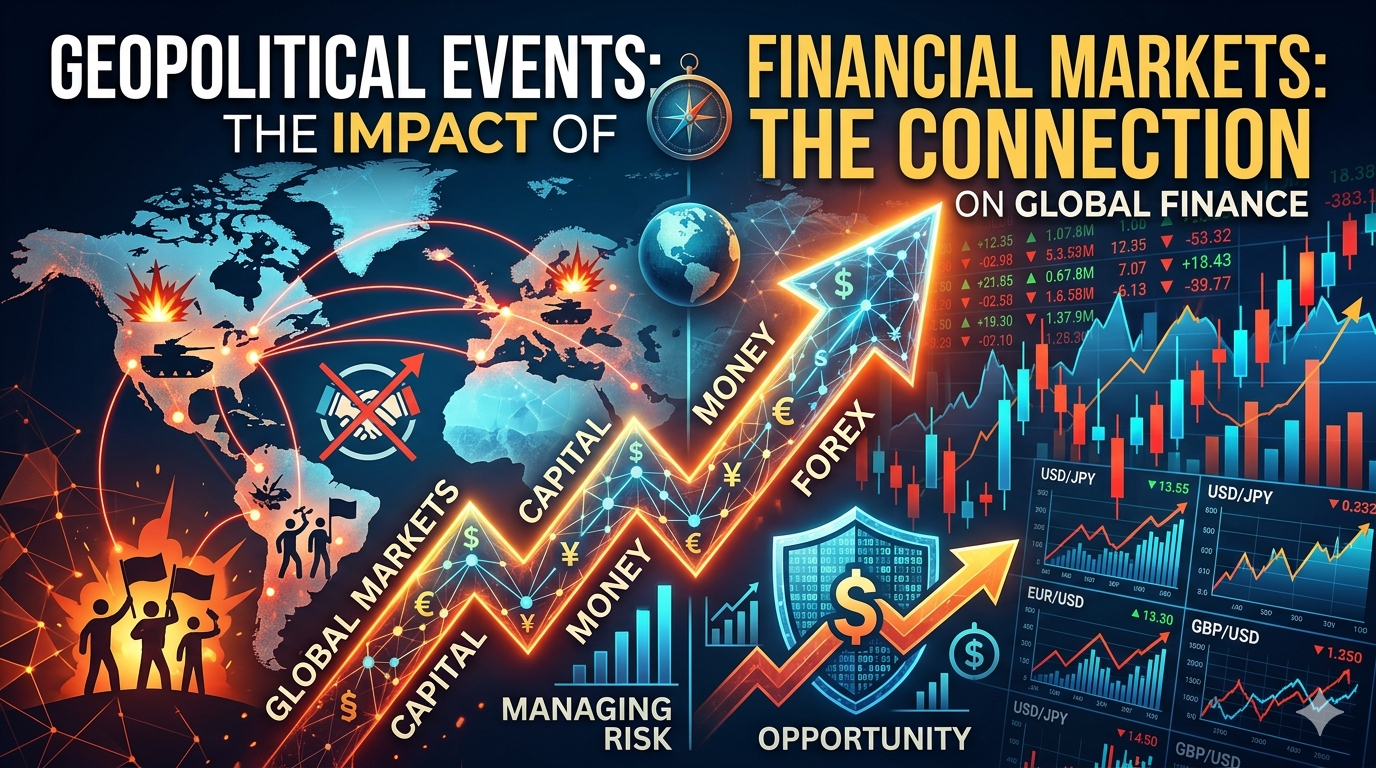
In an increasingly interconnected world, geopolitical events—ranging from military conflicts and trade disputes to political upheavals and international sanctions—play a critical role in shaping global financial markets. These events can trigger sudden shifts in investor behaviour, disrupt trade and supply chains, and lead to volatility in stock markets, currency exchange rates, commodity prices, and interest rates.
Understanding the complex relationship between geopolitics and financial markets is essential for investors, policymakers, and businesses seeking to manage risk and make informed decisions. This analysis explores how geopolitical developments influence financial instruments and economic stability, highlighting the importance of geopolitical awareness in today's globalized economy.
Geopolitical events represent a critical source of market risk and opportunity. Conflicts, political instability, sanctions, and international tensions can dramatically influence asset prices, investor sentiment, and global capital flows. These events often lead to heightened market volatility, shifts in currency values, and disruptions in commodity and energy markets — all of which can significantly impact investment portfolios.
In today’s interconnected world, geopolitical developments are no longer isolated regional concerns; they have global ripple effects that influence equity markets, bond yields, and the strategic decisions of institutional and retail investors alike. As such, understanding the relationship between geopolitics and financial markets is essential for managing risk, preserving capital, and identifying potential investment opportunities in uncertain environments.
IMPACT ON CAPITAL MARKET
Geopolitical events—such as wars, international conflicts, trade disputes, and political instability—can have profound effects on capital markets, which include the stock and bond markets. These events often generate uncertainty, which directly influences investor behaviour, market valuations, and the flow of capital across global economies.
Geopolitical events refer to occurrences that stem from political power struggles, international conflicts, and diplomatic tensions between nations. These events include wars, political instability, terrorist attacks, trade disputes, and significant elections. When such events occur, they often introduce a high level of uncertainty into the global economy, which can have a profound impact on capital markets. Investors react to this uncertainty by reassessing risk, adjusting portfolios, and sometimes pulling out of markets entirely, causing significant fluctuations in asset prices.
One of the most immediate ways geopolitical events affect capital markets is through shifts in investor sentiment. In times of heightened tension or conflict, investors typically become more risk-averse. This risk aversion leads them to withdraw from volatile assets such as equities and shift their capital into traditionally safer investments like government bonds, gold, and currencies such as the U.S. dollar or the Japanese yen. As a result, equity markets often experience sharp declines during major geopolitical disruptions, while safe-haven assets see increased demand and rising prices.
Commodities, particularly oil and gold, are also highly sensitive to geopolitical developments. For example, conflicts in oil-producing regions, like the Middle East or Eastern Europe, tend to push oil prices higher due to fears of supply disruption. Higher oil prices, in turn, can lead to inflation and impact the profitability of companies in energy-intensive sectors. Gold, on the other hand, typically acts as a store of value and sees price increases as investors seek stability. These movements can significantly alter the performance of various sectors in the capital markets.
Central banks and policymakers often respond to geopolitical shocks by adjusting monetary policy to stabilize markets. They may lower interest rates or implement quantitative easing to provide liquidity and restore investor confidence. However, if the geopolitical event leads to inflationary pressures—such as through rising commodity prices—central banks may face a dilemma between supporting growth and controlling inflation.
IMPACT ON MONEY MARKET
Geopolitical events also have a significant impact on the money market, which is the segment of the financial system where short-term borrowing, lending, and liquidity management take place—typically involving instruments with maturities of one year or less, such as Treasury bills, commercial paper, certificates of deposit, and repurchase agreements.
During periods of geopolitical tension or conflict, investor sentiment shifts sharply, and one of the first areas to reflect this shift is the money market. As uncertainty increases, investors and financial institutions tend to seek safety and liquidity. This often leads to a surge in demand for high-quality, short-term instruments, particularly government securities like U.S. Treasury bills. This increased demand pushes the yields on these instruments lower due to their safe-haven status. In contrast, yields on riskier instruments like commercial paper or emerging market short-term debt may rise, reflecting the increased perceived risk.
Another major channel through which geopolitical events affect the money market is through liquidity conditions. If the events trigger a crisis of confidence or disrupt global trade and financial flows, liquidity in the money market can dry up. This happened during past crises like the 2008 financial crisis and the onset of the COVID-19 pandemic in 2020—although the latter was more health-related, it had strong geopolitical implications. In such scenarios, banks and other financial institutions become more reluctant to lend to each other, leading to increased interbank lending rates (e.g., LIBOR or SOFR), and a tighter credit environment.
IMPACT ON FOREIGN EXCHANGE MARKET
Geopolitical events can have a swift and substantial impact on the foreign exchange (forex) market, as currency values are highly sensitive to changes in global risk sentiment, capital flows, and economic stability. The forex market is the most liquid and globally integrated financial market, making it particularly responsive to real-time geopolitical developments such as wars, trade disputes, sanctions, political instability, and diplomatic tensions.
When geopolitical tensions rise, investors often engage in "flight to safety"—a phenomenon where capital moves rapidly into perceived safe-haven currencies. The U.S. dollar (USD), Swiss franc (CHF), and Japanese yen (JPY) are traditionally viewed as safe-haven currencies due to the stability of their economies and strong institutional frameworks. As a result, during crises like the Russia-Ukraine war or periods of Middle East conflict, these currencies typically appreciate as global investors reduce their exposure to riskier assets and currencies
Conversely, currencies of countries directly involved in or geographically close to geopolitical hotspots often depreciate. This depreciation is driven by capital flight, concerns over economic disruption, inflation risks, or political instability. For example, during the Russia-Ukraine conflict, the Russian ruble initially plummeted due to sanctions and investor withdrawal. Similarly, emerging market currencies often come under pressure during global crises, even if the countries themselves are not directly involved, as investors reassess their risk appetite.
Team ELPL